 BuildCalcs
 Concrete Calculator UK
Calculate concrete in cubic metres (m³) and litres for slabs, shed bases, strip footings and post holes. Add an allowance, estimate bags from the manufacturer’s stated yield and combine several sections into one project total.
Reviewed: 20 September 2026 · How we check calculations
How much concrete do I need?
Choose the shape closest to your project, enter the finished dimensions and calculate the volume. BuildCalcs shows the base volume, your selected allowance, the planning quantity in cubic metres and the equivalent litres. If the job has several areas or different depths, add each section to the project total rather than forcing everything into one average measurement.
Concrete formulas used
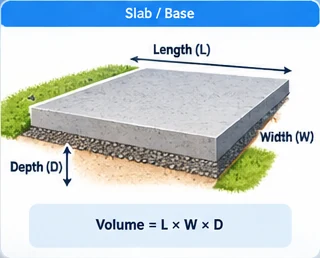
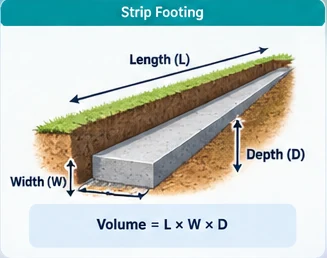
- Rectangular slab, base or footing: length × width × depth.
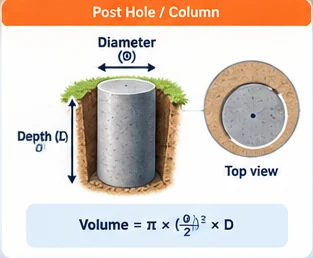
- Round post hole or column: π × radius² × depth × quantity.
Millimetre inputs are converted to metres before the calculation. The selected allowance is added only after the measured base volume has been calculated.
Worked example: 4 m × 3 m shed base at 100 mm
A 4 m by 3 m base has an area of 12 m². At 100 mm deep, its measured concrete volume is 1.20 m³. With a 5% allowance, the planning quantity becomes 1.26 m³, equivalent to 1,260 litres.
Bagged concrete: use the manufacturer's yield
Bag weight alone does not tell you the finished volume of mixed concrete. If you plan to use bags, check the packaging or technical data for the manufacturer's stated mixed yield in litres per bag. Enter that figure above and the calculator will divide the required project litres by the stated yield, rounding up to a whole bag.
Ready-mix concrete price per m³ and cost estimate
Ready-mix is commonly quoted by volume in cubic metres. Enter a current supplier quote in the optional price-per-m³ field and the calculator multiplies it by the planning quantity. This is a material estimate, not a live price: delivery, minimum-load, part-load, waiting-time, pumping and access charges may be separate.
Confirm the required concrete specification, minimum order and delivery method with the supplier before ordering. A cheaper price per m³ does not necessarily produce a lower delivered total once job-specific charges are included.
Useful depth conversions
| Depth | Metres used in volume calculation |
|---|---|
| 50 mm | 0.050 m |
| 75 mm | 0.075 m |
| 100 mm | 0.100 m |
| 125 mm | 0.125 m |
| 150 mm | 0.150 m |
| 200 mm | 0.200 m |
Concrete required per square metre
If you already know the area, this table gives a fast sense-check for common depths. It shows the measured volume before any allowance is added.
| Concrete depth | Concrete per 1 m² | Area covered by 1 m³ |
|---|---|---|
| 50 mm | 0.050 m³ / 50 L | 20.00 m² |
| 75 mm | 0.075 m³ / 75 L | 13.33 m² |
| 100 mm | 0.100 m³ / 100 L | 10.00 m² |
| 125 mm | 0.125 m³ / 125 L | 8.00 m² |
| 150 mm | 0.150 m³ / 150 L | 6.67 m² |
| 200 mm | 0.200 m³ / 200 L | 5.00 m² |
Concrete m³ to bags: use the stated mixed yield
Bag counts vary because different products produce different volumes when mixed. The safest conversion is required litres ÷ stated mixed yield per bag, rounded up. For example, the table below shows how many bags would be needed for exactly 1 m³ (1,000 litres) before any allowance.
| Stated mixed yield per bag | Bags for 1 m³ | Calculation |
|---|---|---|
| 8 L | 125 bags | 1,000 ÷ 8 |
| 10 L | 100 bags | 1,000 ÷ 10 |
| 12 L | 84 bags | 1,000 ÷ 12 = 83.34, rounded up |
| 15 L | 67 bags | 1,000 ÷ 15 = 66.67, rounded up |
More worked concrete examples
| Project | Dimensions | Measured concrete | With 5% allowance |
|---|---|---|---|
| Small slab | 3 m × 2 m × 100 mm | 0.600 m³ | 0.630 m³ |
| Shed base | 4 m × 3 m × 100 mm | 1.200 m³ | 1.260 m³ |
| Strip footing | 10 m × 0.6 m × 225 mm | 1.350 m³ | 1.418 m³ |
| 10 round post holes | 300 mm diameter × 600 mm deep | 0.424 m³ | 0.445 m³ |
Measuring concrete projects accurately
Measure the actual prepared area where practical rather than relying only on nominal plan dimensions. Excavations and sub-bases can vary in depth, so split irregular work into sensible sections and add them to the project total. For round post holes, measure the hole diameter and depth rather than the post itself.
Frequently asked questions
How many litres are in one cubic metre of concrete?
One cubic metre equals 1,000 litres. BuildCalcs shows both cubic metres and litres so you can compare ready-mix quantities with product yields.
Can I calculate concrete for several areas at once?
Yes. Calculate one section, choose Add section, then enter the next area. The project total combines the measured volumes and applies the selected allowance to the combined quantity.
Can I calculate concrete for post holes?
Yes. Choose Round post hole / column, enter the diameter, depth and number of identical holes. The calculation uses the volume of a cylinder.
How many bags of concrete do I need?
Enter the mixed yield in litres stated by the manufacturer. BuildCalcs divides the required litres by that yield and rounds up to a whole bag. It deliberately does not assume that every bag of the same weight has the same yield.
What allowance should I use?
The calculator defaults to 5%, but the appropriate allowance depends on measurement accuracy, excavation conditions and supplier guidance. You can change it from 0% to 30%.
How much concrete do I need for 1 m² at 100 mm thick?
One square metre at 100 mm thick requires 0.10 m³ of concrete, which is 100 litres, before any allowance is added.
How many square metres does 1 m³ of concrete cover?
Coverage depends on depth. At 100 mm, 1 m³ covers 10 m²; at 150 mm it covers about 6.67 m²; and at 200 mm it covers 5 m².
Can this calculator estimate ready-mix cost?
Yes. Enter the price per cubic metre from a supplier quote and the calculator will multiply it by the planning quantity. Delivery, minimum-load, waiting-time and other charges are not included unless they are already built into the price you enter.